Why Do Some Families Always Have Boys or Girls
Traditional views hold that the human offspring sex ratio follows a simple binomial distribution(similar to a coin toss),i.e., each fertilization event is independent and random, determined by the XorYchromosome carried by the sperm. However, in reality, some families have only single-gender offspring (e.g., multiple consecutive boys or girls),raising questions about whether sex determination is entirely random.Existing theories suggest, that genetic and environmental factors may influence the sex ratio to enhance offspring's reproductive fitness. For example, some studies have found that parents with outstanding appearance are more likely to have daughters, ,some studies have found that parents with outstanding appearance are more likely to have daughters, Additionally, maternal factors (such as vaginal pHbody temperature, and menstrual cycle )may affect the survival rate of XorYsperm.However, these hypotheses have not been confirmed in large-scale epidemiological studies.

1.Study Design and Data
The study was based on two large-scale U.S. Nurses' Health Studies(NHSIIadnNHS3), analyzing the sex distribution of 58,007women and their 146,064offspring.
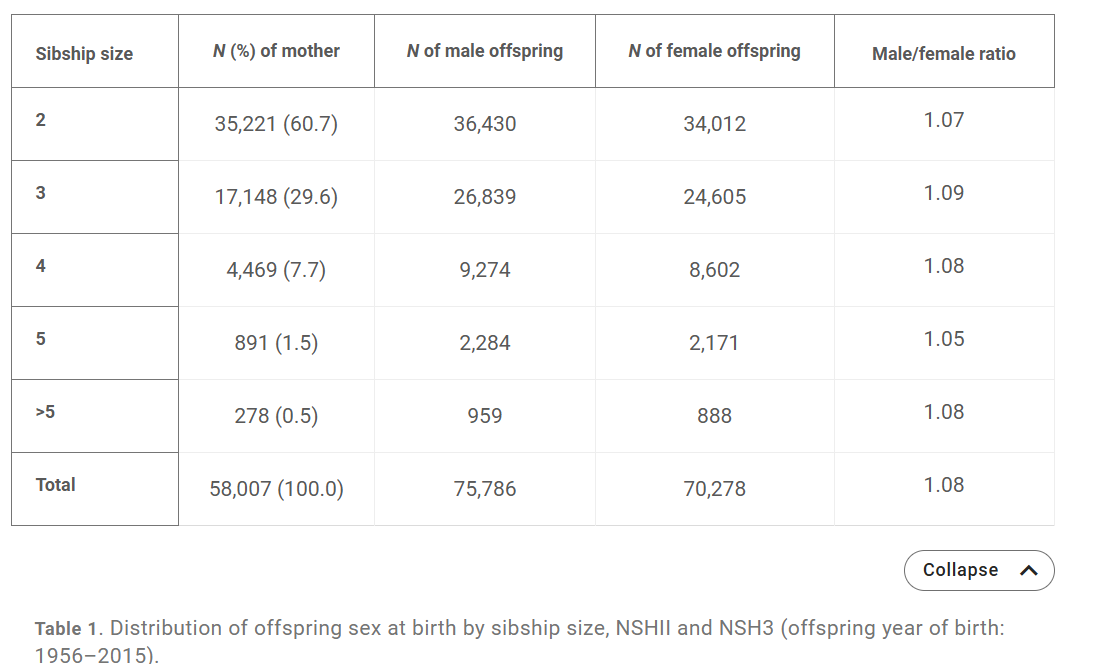
(Partial data excerpt)
Key Research Questions:
1)Does the birth sex ratio conform to a binomial distribution or β-binomial distribution?
2)Are there genetic or phenotypic characteristics(e.g., hair color, blood type, height, age at first birth)associated with having single-gender offspring?
2.Major Findings:
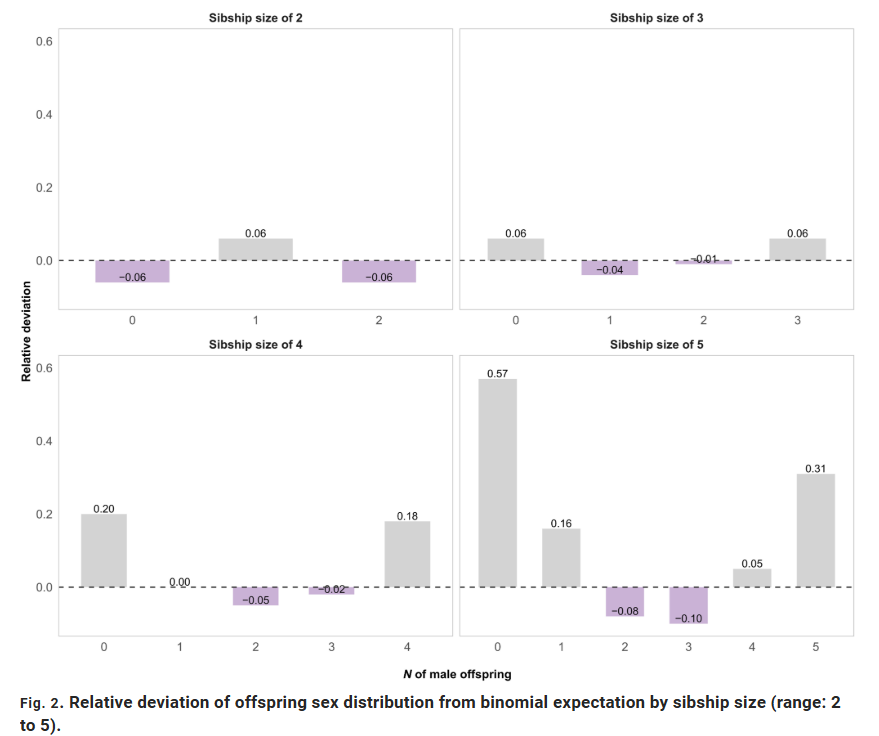
Sex distribution deviates from the binomial distribution:In families with a large size(≥3children)),the proportion of families with single-gender offspring is significantly higher than expected by the binomial distribution,,consistent with a β-binomial distribution, indicating differences in the probability of male (Pboy)offspring among different mothers.
Sensitivity analysis:Results remained robust after excluding “coupon collector behavior”(parents stopping childbirth due to preference ),for a specific gender.
Risk Factors:
1)Age at childbirth:Mothers who have their first child at an older age (>28years)are more likely to have single-gender offspring.
2)Other factors:Race, hair color, blood type, height, body mass index (BMI), etc., (BMI)have no significant association with offspring sex.
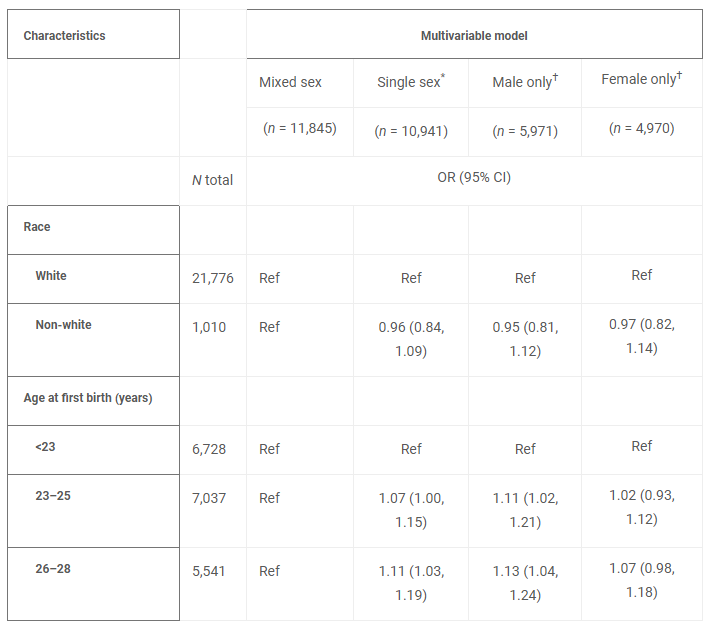
(Partial data excerpt)
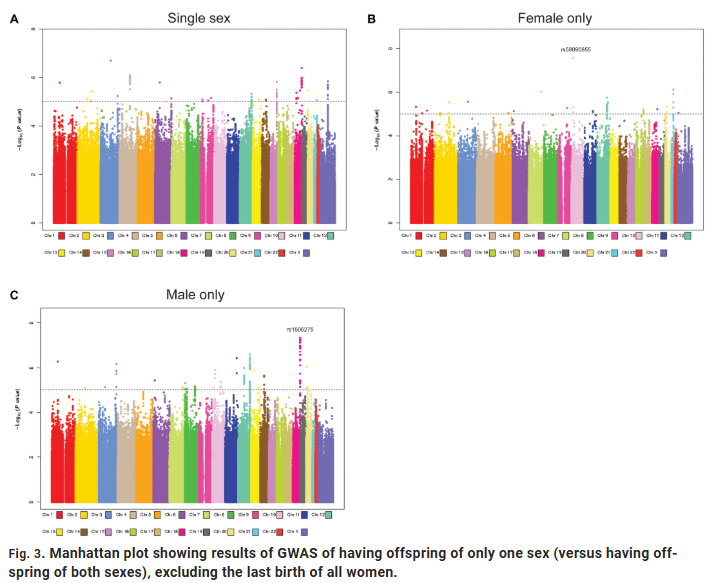
3)GWASanalysis:found that some maternal genetic loci (e.g., CYP2U1、NSUN6、 TSHZ1near genes)are associated with having single-gender offspring ,but have not reached genome-wide significance.
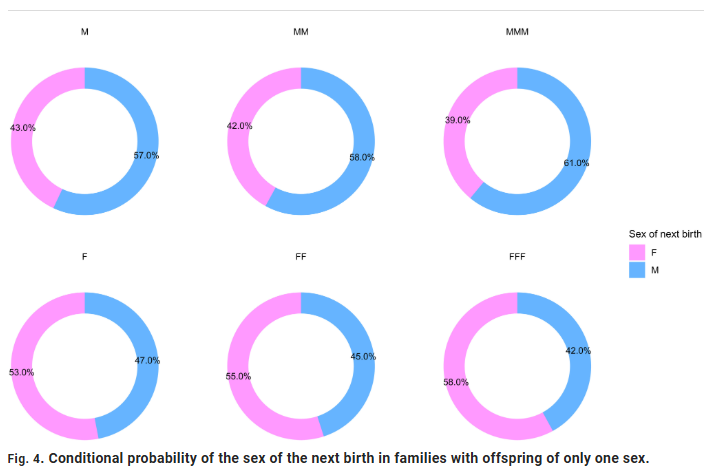
3.Conditional Probability Analysis:
In families that have already had multiple same-gender children, ,the probability of the next child having the same gender is higher. (For example, ,families that have had3boys have a,probability of having another boy.61%)。
Main Conclusions:
1)Offspring sex distribution is not entirely random , but shows clustering at the family level,especially in families with multiple children.
2)This clustering may be jointly driven((e.g., maternal genetics or physiological characteristics) and reproductive behaviors(e.g., delayed childbirth or gender preference)by biological factors.
3)Mothers who have their first child at an older age are more likely to have single-gender offspring, but other phenotypic characteristics (e.g., height, blood type)have no significant impact.
4.Study Significance and Limitations:
1)Significance:The study has challenged the traditional assumption of random sex determination and provided new evidence for the biological mechanism of the sex ratio.
2)Limitations::
-Lack of paternal data makes it impossible to analyze the impact of paternal inheritance.
-With U.S. white nurses being the main study population, , results may not be applicable to other groups. -Also, it fails to fully exclude interference from cultural or social factors on reproductive decisions.
5.Future Directions:
1)Further validation of the identified genetic loci is needed, and exploration of the interactions between environment and genes should be conducted.
2)Also, the study population should be expanded to include more diverse sociocultural backgrounds.
6.Final Insight:
For families that have already had multiple children of the same sex, if they hope for a child of a different sex next, they need to be aware that biological factors may make this probability lower than expected—akin to "flipping a coin that consistently lands on the same side."






 Official Account
 Rednote
 Weibo
Weibo Instagram
 YouTuBe
 Close
Close


